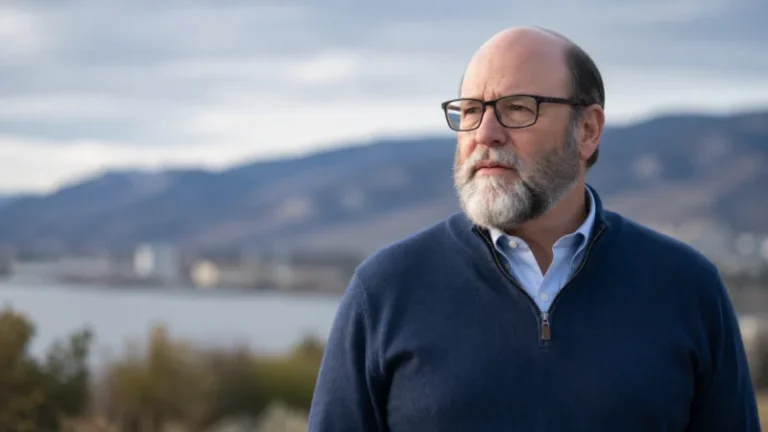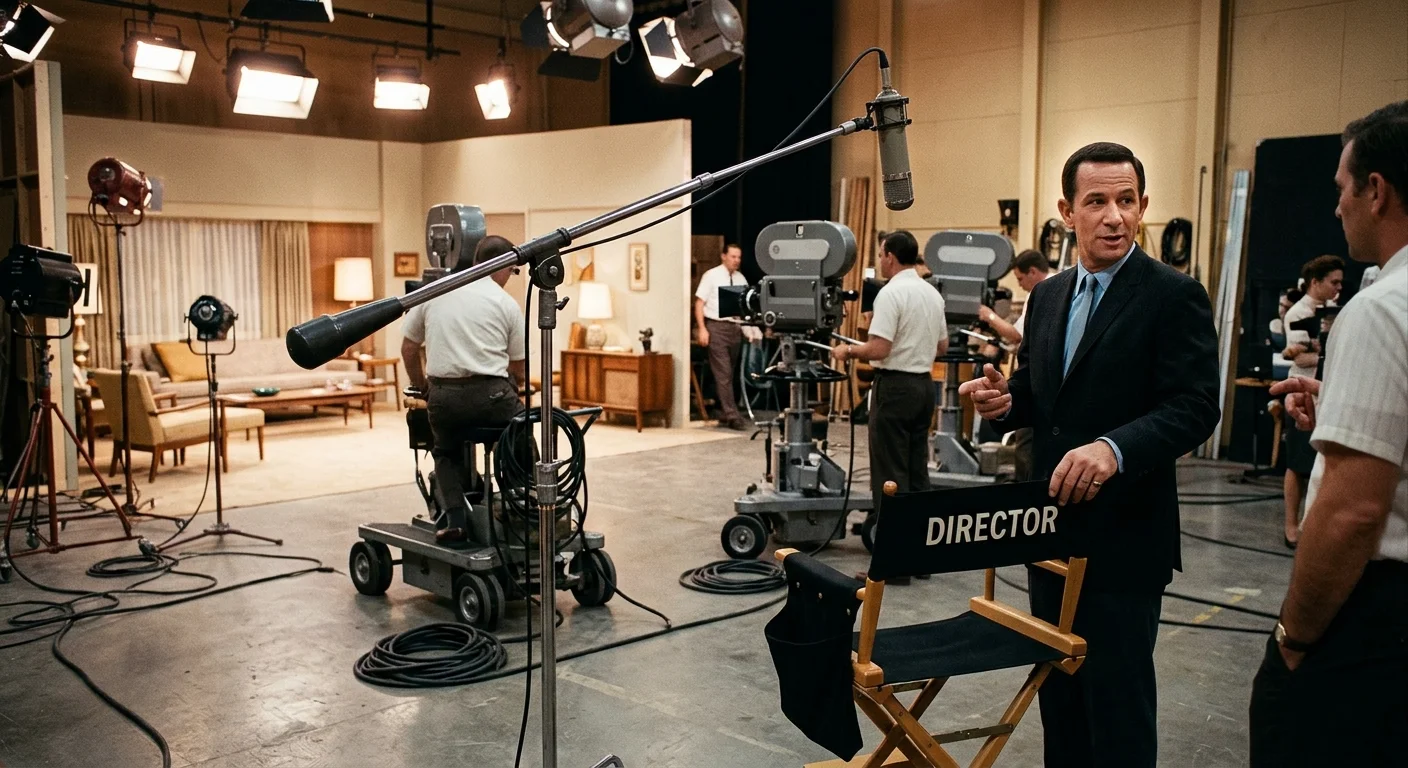
Don Adams spent nearly five decades in American television, but most people know him for one role: Maxwell Smart, the accident-prone spy at the center of Get Smart. Before he ever put on Agent 86’s trench coat, Adams survived Guadalcanal as a Marine, worked as a commercial artist, and clawed his way through New York’s comedy clubs. His path to stardom took over twenty years.
Early Life in New York City
Adams was born Donald James Yarmy on April 13, 1923, in Manhattan. His father, William Yarmy, managed a restaurant and came from a Hungarian Jewish family. His mother, Consuelo Deiter Yarmy, was Irish American and raised her son Catholic. He grew up the middle child in a household that valued hard work over show business connections, and nothing in his childhood pointed toward a comedy career.
He attended DeWitt Clinton High School in the Bronx but left before finishing, dropping out during his senior year in 1941. He was sixteen. That decision would soon collide with a much larger event: the United States’ entry into World War II.
Marine Corps Service and Guadalcanal
Adams enlisted in the United States Marine Corps in 1941. He served in the Pacific theater and took part in the brutal fighting at Guadalcanal, one of the most physically punishing campaigns American forces faced during the war. While stationed there, he contracted malaria and became seriously ill. He recovered and returned to the United States, where he served the remainder of his enlistment as a drill instructor.
The war years shaped him in ways that rarely showed up in his comedic persona. Few of his television fans in the 1960s would have guessed that the actor playing a bumbling secret agent had actually served in real combat.
From Commercial Artist to Stand-Up Comic
After his discharge, Adams tried a series of ordinary jobs. He worked as a commercial artist and did engineering design work, neither of which held his interest for long. As a kid, he had entertained classmates with movie star impressions, and that instinct for performance never fully left him.
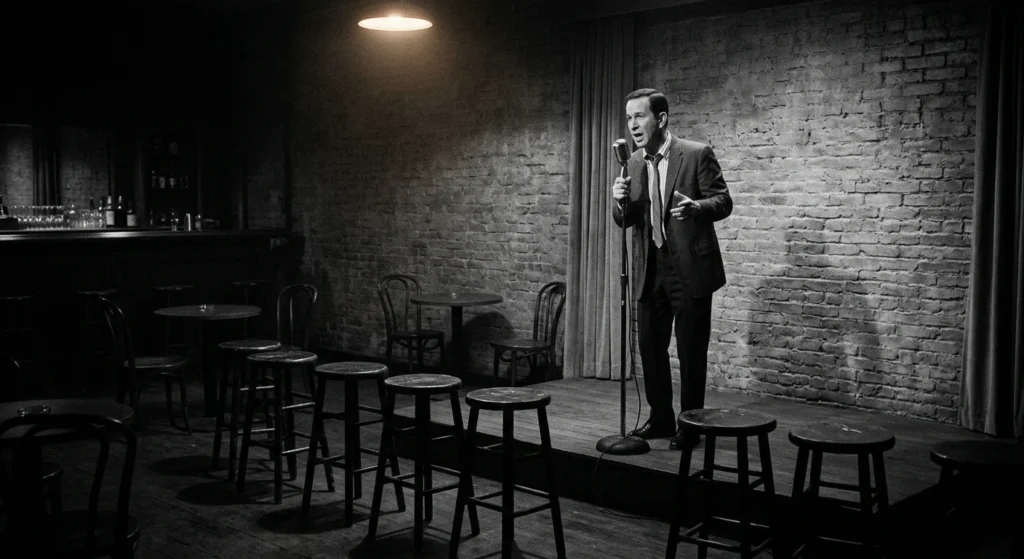
He began testing stand-up material and impressions in New York clubs, with mixed results at first. His break came when he won the talent competition on Ted Mack and the Original Amateur Hour in 1948. The win opened doors, leading to television appearances on programs like The Steve Allen Show and slowly building his reputation as a comic performer worth watching.
Byron Glick and The Bill Dana Show
Before Get Smart, Adams built a following playing Byron Glick, a bumbling hotel detective, on The Bill Dana Show from 1963 to 1965. The character let Adams refine a comic voice built around clipped, deadpan delivery and exaggerated confidence undercut by incompetence. It was a rehearsal, in effect, for the role that would define his career.
By the time producers Mel Brooks and Buck Henry were developing a new spy spoof for television, Adams had already tired of playing variations on the Glick character. Accounts from the era describe him as reluctant to take the part that became Maxwell Smart, and it reportedly took some persuading from Bill Dana before he agreed to the role.
Get Smart and Agent 86
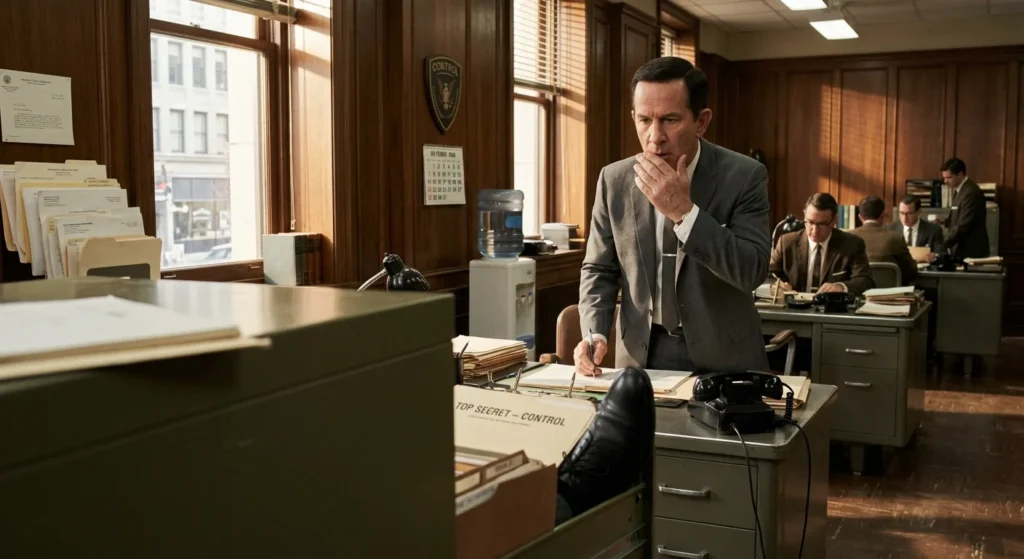
Get Smart premiered on NBC in 1965. The show parodied the spy craze that James Bond and The Man from U.N.C.L.E. had sparked earlier in the decade, following Maxwell Smart, Secret Agent 86 of the agency CONTROL, as he blundered through missions against the enemy agency KAOS. Barbara Feldon played his sharper, more competent partner, Agent 99, and Edward Platt played the long-suffering Chief.
The series ran on NBC from 1965 to 1969, then moved to CBS for a final season through 1970. Adams won three consecutive Emmy Awards for Best Actor in a Comedy Series between 1967 and 1969, and the show itself picked up a fourth Emmy along the way. Adams didn’t just act in the series. He also directed and wrote episodes over its run, giving him more creative control than most sitcom leads of the period had.
His financial arrangement on the show reflected real confidence in its staying power. Rather than take a flat weekly salary of around $12,500 per episode, Adams opted for a smaller upfront payment combined with a 33 percent ownership share. That bet paid off through decades of syndication.
The supporting cast gave the show extra texture. Bernie Kopell recurred as KAOS operative Siegfried, and guest villains over the years included Vincent Price, Julie Newmar, and Ted Knight. According to Buck Henry, the show grew out of a request to combine the two biggest things in entertainment at the time, the James Bond franchise and Inspector Clouseau, and Mel Brooks later described the result as a mix of Bond and his own brand of comedy. Get Smart ran 138 episodes across five seasons and collected seven Emmy Awards along with two Golden Globe nominations, including a nomination for Adams himself as Best Actor in a Television Series in 1966.
Behind the Camera: Directing and Writing
Adams didn’t limit his contribution to acting. Over the course of the series, he directed 13 episodes and wrote two of them, giving him a hand in shaping the show’s pacing and comic rhythm from behind the camera as well as in front of it. That directing experience carried into his later career, where he built a reputation directing television commercials after the show ended.
Life After the Original Series
Get Smart’s cancellation in 1970 didn’t end Adams’ career. He returned to the role for the 1980 film The Nude Bomb and the 1989 television movie Get Smart, Again! In 1995, he reprised Maxwell Smart one more time for a short-lived revival series in which his character had been promoted to Chief of CONTROL. Barbara Feldon returned as well, though the new show centered on their son taking up the family spy business. Only seven episodes aired before it was cancelled.
Away from live-action work, Adams built a substantial career in animation. He voiced Tennessee Tuxedo on Tennessee Tuxedo and His Tales from 1963 to 1966, using a vocal style that predated and resembled his later Maxwell Smart delivery. Starting in 1983, he voiced Inspector Gadget, a bumbling detective character with obvious echoes of Agent 86, across the original series and several 1990s follow-up productions. In 1999, he made a cameo voice appearance in the live-action Inspector Gadget film starring Matthew Broderick.
He also hosted Don Adams’ Screen Test in 1975, a syndicated show in which contestants reenacted famous movie scenes alongside celebrity guests, a format that anticipated later reality competition television. He later voiced the character Sid Pickles across the animated series Spike & Mike and its two follow-up films, adding another recurring animated role to his resume alongside Tennessee Tuxedo and Inspector Gadget. In later years, he found steady work directing and appearing in commercials, including a memorable run for GTE Calling Services.
Personal Life
Adams married three times and had seven children. He and his first wife, Adelaide Efantis, married in 1947 and divorced in 1960; they had four children together. His second marriage, to Dorothy Bracken from 1960 to 1976, produced two more children. His third wife, Judy Luciano, whom he married in 1977 and divorced in 1990, was the mother of his seventh child. One of his daughters, Cecily Adams, became a working actress and casting director, best known to television audiences for a recurring role on Star Trek: Deep Space Nine.
His younger brother, Dick Yarmy, also became a comic actor and worked in television throughout his own career. The two brothers shared a taste for horse racing that Adams kept up throughout his life.
Death and Legacy
Don Adams had been diagnosed with bone lymphoma more than two years before his death. He died on September 25, 2005, at Cedars-Sinai Medical Center in Los Angeles, from complications of a lung infection, at age 82. He was buried at Hollywood Forever Cemetery. In place of flowers, his family suggested donations to the Motion Picture and Television Fund, an organization that supports entertainment industry workers. He did not live to see Warner Bros. release its 2008 feature film adaptation of Get Smart, starring Steve Carell as Maxwell Smart, which introduced the character to a new generation of viewers.
More than five decades after Get Smart first aired, Adams remains closely tied to a specific style of American television comedy: gadget-driven spy satire delivered with total deadpan sincerity. His signature catchphrases, including “Missed it by that much” and “Would you believe…,” stayed in the pop culture vocabulary long after the original series left NBC’s schedule. For American audiences who grew up on network reruns and later cable syndication, Adams’ voice and mannerisms as both Maxwell Smart and Inspector Gadget remain instantly recognizable.
His career also stands as a reminder of how long a path to stardom can run. Adams spent roughly two decades doing stand-up, impressions, and supporting television work before Get Smart made him a household name at 42. That timeline rarely gets mentioned alongside the catchphrases, but it shaped the confident, unhurried comic timing that made Maxwell Smart work.
The character’s double life as both a spy parody and a genuine action lead also set a template that later shows and films borrowed from directly. Get Smart’s mix of physical comedy, absurd gadgets, and a hero who somehow succeeds despite himself influenced decades of spy comedy that followed, from feature film spoofs to sitcom pastiches. Adams’ willingness to play Smart with complete sincerity, rather than winking at the audience, is often cited as the reason the joke kept working across 138 episodes without wearing thin.
His daughter Cecily Adams carried a version of that same work ethic into her own career, building a long résumé as both an actress and a casting director in addition to her recurring television role. Between his own body of work and the careers his family members built afterward, Adams’ influence on American television comedy extended well past his own screen credits, touching casting rooms and writers’ rooms for years after Get Smart went off the air.